Spaß und Bewegung zur lebensfrohen irischen Musik
Irish Set Dance ist die weltweit beliebteste irische Tanzform und d e r irische Volkstanz schlechthin; nicht zu verwechseln mit dem hüpfenden Step Dance.
Es ist für jeden geeignet, vom Kind bis zum Senior im hohen Alter, machbar auch ohne tänzerische Vorerfahrung und ohne eigenen Partner. Spaß bei der Bewegung zur lebensfrohen irischen Musik stehen im Vordergrund.

Typisch ist das Tanzen in Gruppen mit jeweils vier Paaren, die sich in leichter Schrittfolge durch verschiedene Figuren choreografierter Tänze bewegen. Je nach Choreografie tanzen wechselweise entweder einzelne Paare, zwei Paare oder auch alle Tänzer gleichzeitig. Oben die sogenannte »Chain« der 5. Figur des Mazurka Sets.

Ein choreografierter Tanz (das Set) besteht meist aus einer sich wiederholenden Grundstruktur für den Beginn und das Ende. Dazwischen sind individuelle, Set-typische Figuren eingebunden, die in unterschiedlicher Paarung getanzt werden. Sehr beliebt sind die »Christmas-Figuren«, bei denen sich entweder zwei oder auch vier Paare eng umschlungen schwungvoll synchron umeinander drehen.
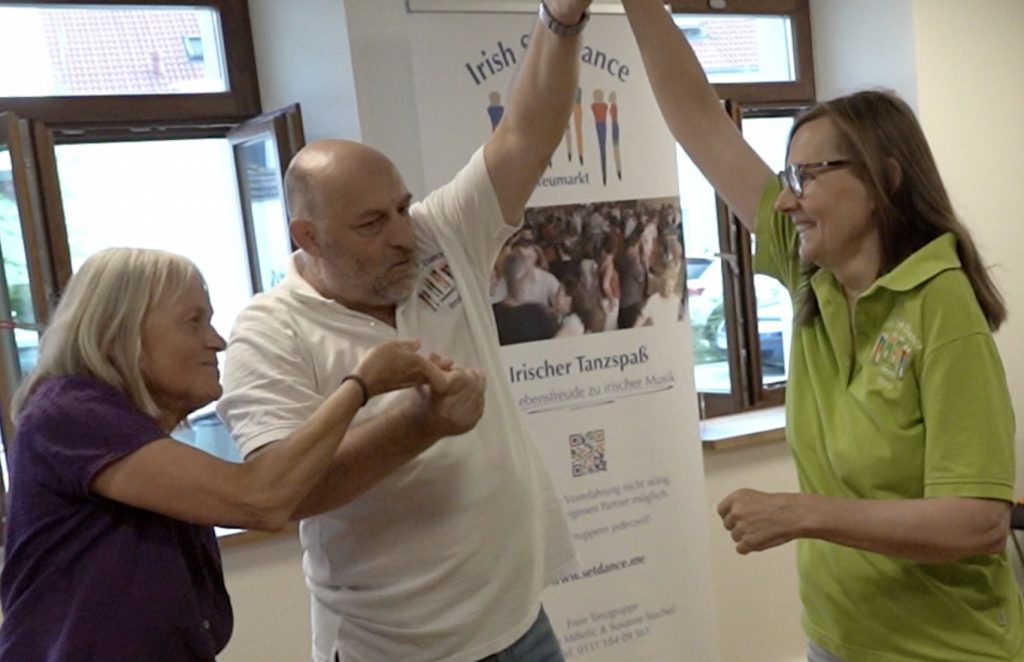
Manche Figuren erfordern eine geschickte Koordination von Fuß- und Armarbeit im Takt der Musik und wirken wie »Gehirn-Jogging« . Wenn es manchmal nicht gleich auf Anhieb klappen sollte, ist das überhaupt kein Problem, sondern immer ein Anlass für Heiterkeit und Lachen, das zur spielerischen Wiederholung einlädt.
Geistige und körperliche Fitness
Irish Set Dance hat darüber hinaus auch einen Effekt auf die eigene geistige und körperliche Fitness. Das wurde sogar wissenschaftlich untersucht. Der italienischer Neurologe, Dr. Daniele Volpe, der selbst irische Fiddle spielt und in Irland wiederholt Set Tänzer mit Parkinson-Erkrankung tanzen sah, hat sogar eine wissenschaftliche Studie zur Frage durchgeführt, ob Irish Set Dance für Parkinson-Patienten einen positiven Effekt auf ihren gesundheitlichen Zustand hat. Die signifikanten Ergebnisse bestätigten seine Vermutung und er empfiehlt Set Dance als Begleittherapie; nachzulesen unter https://pubmed.ncbi.nlm.nih.gov/28336345/ .
Hier ein Video mit der Vorführung des Antrim-Sets durch Parkinson-Patienten: https://youtu.be/Q9GfFF-MF68
Was Set Dancing ist – aus irischer Sicht
(Quelle: Facebook-Post von »The Irish Way« vom 18.9.2026)
»Four couples in a square, a caller shouting over an accordion, and a hall floor that has been polished by boots for eighty years. This is the dancing most Irish people actually did. 👭 Set dancing.
When the world thinks of Irish dancing it pictures solo step dancing, the high kicks and the rigid arms and the competition stage. But the dancing that filled the halls and kitchens of Ireland for generations, the dancing ordinary people did on a Sunday night, was set dancing, and it is a different thing entirely.
A set is danced by four couples arranged in a square, and it is built from a sequence of figures, each with its own tune and rhythm, reels and jigs and hornpipes and polkas, worked through one after another with short breaks between. It is social rather than performative. You are constantly interacting with the other three couples, swinging, changing places, moving through the house, and the whole thing only works if everybody holds their shape. The footwork is close to the floor and battering, driven, percussive, and in a hall full of dancers the sound of it is extraordinary, a whole room drumming in time.
The origins are a lovely piece of cultural borrowing. The square formation came from the French quadrilles that spread across Europe around the early nineteenth century, arriving in Ireland through the towns and the garrisons. Irish dancers took the form and rebuilt it around their own music and their own footwork, and what came out the far end was something entirely Irish. Then it localised further, so that different areas developed their own sets with their own figures and their own favoured tunes, the Caledonian in Clare, the Plain Set, the Connemara sets, the Kerry and Sliabh Luachra polka sets. You can often tell where a dancer learned by watching them move.
The céilí, the organised dance in the hall, became the main social event for young people in rural Ireland for decades, and a great many marriages started on those floors. Set dancing declined through the 1960s and 70s as showbands and discos took over, and then something unusual happened. It came back, strongly, from the 1980s onward, driven by a deliberate revival, and there are now set dancing classes, weekends and workshops all over Ireland and well beyond it. The floors are being polished again. The dancing the whole country actually did. 💚
The great social dance tradition of Ireland, set dancing, four couples in a square working through a sequence of figures, built out of the French quadrille and rebuilt around Irish music and percussive footwork, with distinct local sets from Clare to Kerry.«